
Views: 0 Author: Site Editor Publish Time: 2026-04-12 Origin: Site
Upgrading vacuum web coating lines requires balancing high-speed throughput and strict barrier quality standards. Traditional drum-based resistance metallizers often bottleneck your production. You face severe thermal limitations and frustrating contact-induced defects daily. These specific issues harm your overall output yield. They also steadily inflate operating expenses over time. You need a vastly superior approach to handle modern flexible films. Transitioning to advanced equipment resolves dangerous substrate thermal stress. It eliminates contact defects entirely. It significantly improves your long-term Total Cost of Ownership (TCO). You will discover exactly how this equipment transforms barrier film production. We provide plant managers, process engineers, and operations directors a realistic evaluation framework. You can use these practical insights to directly justify your capital expenditures.
Defect Reduction: Free span web handling removes cooling drum contact, directly enabling pinhole-free and no uncoated lines production.
Material Flexibility: Independent web tension and advanced thermal management ensure multi-substrate compatibility, from ultra-thin PET to heat-sensitive BOPP.
Energy ROI: Induction heating converts over 90% of electrical energy into usable heat, significantly lowering OpEx compared to standard resistance evaporation boats.
Production Capability: Precise temperature control makes the system capable of depositing a wide range of coating materials without sacrificing high-speed output.
Traditional drum-based systems force the film to wrap tightly around a chilled roller. This design creates a severe physical contact problem. Dust, ambient debris, or trapped air easily slip between the moving film and the drum. These contaminants create unwanted thermal bridging issues across the web. You also face constant physical scratching. Scratching ruins the optical clarity and barrier properties of the final product.
Quality rejections happen frequently on legacy machines. You must often rely on physical masking tapes or shields to protect drum edges. These masking effects block the vapor plume unevenly. They directly cause bare edges along the roll length. Furthermore, uneven resistance heating causes localized boiling anomalies. The aluminum spits onto the substrate. This spatter inevitably leads to microscopic pinholes. Food and medical clients reject these flawed rolls immediately.
You also face a massive efficiency gap. Traditional thermal evaporation relies entirely on standard resistance boats. These intermetallic boats degrade extremely quickly under constant thermal stress. They require frequent manual replacement. This process halts your high-speed production schedule. Furthermore, resistance heating acts like an uncontrolled oven. You waste enormous amounts of expensive electrical energy. The system blindly heats non-target surrounding chamber fixtures instead of focusing energy solely on the evaporant material.
Common failures in legacy resistance setups include:
Premature and unpredictable evaporation boat degradation.
Wasted electrical energy transferred to surrounding machine fixtures.
Destructive localized aluminum spatter causing critical barrier failure.
Edge masking constraints limiting usable web width.
Free span technology revolutionizes web handling mechanics. You tension the film safely in open space. You process the coating completely away from solid chilling surfaces. This suspended approach eliminates physical friction entirely. You immediately remove the root cause of contact-based contamination. The substrate remains pristine before entering the vapor deposition zone.
Defect elimination becomes a highly predictable standard. By removing the physical drum edge from the equation, you eliminate restrictive masking requirements. The advanced system guarantees No uncoated lines across the entire web width. You maximize the usable edge-to-edge yield of every single roll. This directly translates to higher profit margins per machine cycle.
High-frequency induction heating introduces unmatched thermal precision. It generates intense heat directly within the evaporation crucible itself. The targeted electromagnetic field prevents the rapid localized overheating seen in legacy resistance systems. You eliminate the destructive "spitting" or spatter commonly seen in degrading resistance boats. Delivering this stable vapor plume ensures a strictly Pinhole-free barrier layer. Food, pharmaceutical, and medical packaging industries demand this exact standard for their critical barrier films.
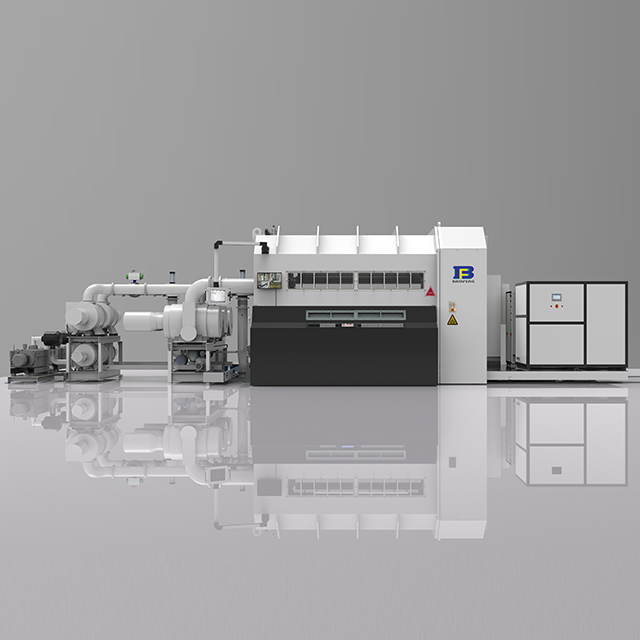
Global packaging trends are shifting rapidly. Brands demand fully recyclable monomaterials today. They also specify increasingly thinner film gauges. These advanced substrates are incredibly sensitive to tension variances. They suffer catastrophic thermal distortion if exposed to excessive radiant heat. Standard resistance drum setups cannot safely process these delicate modern materials.
The free-span design completely separates mechanical web handling from the primary high-heat zone. Because of this separation, it is inherently Compatible with various flexible coating substrates. You can efficiently process demanding materials like CPP, PE, and ultra-thin BOPET. The film absorbs minimal radiant heat. You avoid stretch marks, wrinkles, or melting.
Induction heating delivers incredible coating versatility. The high-temperature capability and precise frequency control allow operators to fine-tune the evaporation environment. Therefore, the system is Capable of depositing a wide range of coating materials. You easily move beyond standard packaging aluminum. You can reliably process copper, silver, and advanced alloys. This remarkable Multi-substrate compatibility future-proofs your manufacturing floor against shifting market demands.
Feature | Resistance Drum Metallizer | Induction Free Span Metallizer |
|---|---|---|
Heating Method | Intermetallic resistance boats | Targeted electromagnetic induction |
Film Handling | Wraps around chilled drum | Suspended tension in open space |
Defect Rate | High (spatter, drum scratches) | Virtually eliminated |
Material Versatility | Limited (aluminum mostly) | High (aluminum, copper, alloys) |
Substrate Suitability | Standard PET, thick films | Ultra-thin BOPET, PE, CPP |
Evaluating your Total Cost of Ownership involves analyzing precise energy utilization. Induction systems rely on Faraday’s law of electromagnetic induction. They create alternating magnetic fields to induce eddy currents. These systems achieve over 90% energy utilization. Unlike traditional ovens or resistance heaters, induction heating acts smartly. It does not waste power blindly heating the surrounding chamber. It directly targets the conductive evaporant.
Consumables and regular maintenance schedules look very different here. Induction coils feature a drastically longer lifespan than standard intermetallic evaporation boats. Resistance boats require constant physical adjustment and replacement. Induction crucibles run consistently for extended periods. Reduced downtime for boat replacement equals higher overall machine uptime. You spend fewer hours cooling the chamber to swap degraded parts.
The ROI timeline presents a compelling business case. The initial CapEx for a Free Span Induction Heating Metallizer machine is notably higher. However, you must weigh this against substantial operational savings. You achieve up to a 67% improvement in constant power efficiency. You process higher yields because of fewer defect rejections. Lower consumable costs round out the equation. The convergence of these factors typically drives a full ROI within 12 to 24 months.
Overcoming path dependency remains a critical management challenge. Transitioning from traditional resistance systems requires dedicated operator buy-in. Factory teams often rely on visual boat degradation to judge the process. They must learn new operational habits. Operators must be trained thoroughly on high-frequency power parameters. Understanding magnetic fields and frequency tuning replaces old visual guesswork.
Web tension control complexity introduces another implementation risk. Moving film in open space requires flawless mechanical synchronization. You cannot rely on drum friction for stability. Free span architecture requires highly sophisticated tension systems. You need active, servo-driven tension control. This advanced engineering prevents dangerous web flutter during high-speed runs. Web flutter ruins coating uniformity immediately.
When shortlisting original equipment manufacturers (OEMs), use strict evaluation criteria. You should demand tangible proof of active closed-loop tension control mechanisms. Always verify the specific cooling efficiency of their induction coil design. Poor coil cooling reduces the lifespan of the equipment. Finally, request formal pilot runs. You must test the system using your thinnest, most heat-sensitive substrate. Do not accept tests run on easy, thick gauge films.
Best practices for equipment rollout include:
Establish a clear baseline of current scrap rates before testing new equipment.
Train maintenance staff on high-voltage induction safety protocols.
Run a pilot trial utilizing your most difficult monomaterial substrate.
Audit energy consumption at the utility meter to verify efficiency claims.
Transitioning to free-span induction technology represents a fundamental structural shift in barrier film manufacturing. It moves your operation far beyond simple incremental upgrades. You decouple delicate substrates from rigid physical drums completely. You replace wildly inefficient resistance heating with targeted electromagnetic induction. Converters successfully solve the root causes of major film defects while drastically lowering long-term TCO. Audit your current scrap rates related to pinholes and edge defects today. Establish this firm baseline before requesting a targeted OEM machine trial.
A: Free span avoids the use of edge masking or the physical boundaries of a cooling drum. It allows full-width, edge-to-edge uniform coating without blocking the vapor plume. You utilize the entire roll width effectively.
A: Yes. Induction provides highly localized, targeted heat directly to the evaporant material. It minimizes unwanted radiant heat transfer to the substrate. Combined with the free-span setup, it handles delicate films safely.
A: It reduces maintenance frequency significantly. Traditional resistance boats degrade quickly and require constant manual adjustment and replacement. Induction crucibles and coils are far more durable. They extend continuous run times between chamber cleanings.
A: For high-volume producers, yes. The direct elimination of scrap caused by pinholes justifies the cost. The massive reduction in consumable replacement costs and the 90% energy transfer efficiency usually yield a fast ROI.


