Views: 0 Author: Site Editor Publish Time: 2026-08-05 Origin: Site
Manufacturing high-barrier films requires a delicate and constant balance. Operators must maintain high-speed throughput while meeting zero-defect quality requirements for sensitive applications. This ongoing conflict often limits production scalability. Traditional drum-based web handling systems present inherent limitations in this environment. They frequently cause thermal distortion, micro-scratching, and pinholing on thin substrates. These physical defects compromise the integrity of food and medical packaging.
To solve this bottleneck, facilities are upgrading their vacuum metallizing ecosystems. Enter the Free Span Metallizer. This structural upgrade fundamentally protects web integrity. It reduces scrap rates and stabilizes high-speed output for highly regulated packaging markets. In this article, you will learn how this contactless architecture re-engineers the web path. We will explore its direct impact on yield metrics, compliance assurance, and implementation realities. Ultimately, you will discover how eliminating mechanical friction elevates your overall equipment effectiveness.
Contactless processing in critical zones eliminates mechanical friction, directly reducing pinhole counts to meet strict OTR (Oxygen Transmission Rate) and WVTR (Water Vapor Transmission Rate) standards.
Advanced tension control and thermal management in free span systems allow for processing thinner, more heat-sensitive substrates without web breaks.
Equipment upgrades require careful evaluation of subsystem integration, particularly regarding induction heating compatibility and rewinder synchronization.
Transitioning to free span architecture reliably increases net usable yield (OEE) by reducing both maintenance downtime and rejected rolls.
Standard cooling drums serve as industry workhorses. However, they bring hidden production penalties. The physical contact creates intense mechanical stress. It also induces significant static buildup. This static attracts microscopic debris directly to the film surface. Thermal shock poses another major issue. Ultra-thin PET and BOPP films react poorly to sudden temperature drops against chilled rollers. Sustainable polymers prove even more vulnerable. They frequently warp upon direct contact.
Micro-defects destroy product integrity instantly. A single mechanical scratch ruins a barrier layer. Pinholes cause immediate batch compliance failures. When this happens, medical pouches lose their essential sterility. Food packaging suffers rapid shelf-life degradation. Highly regulated industries cannot afford these specific compromises. They demand absolute perfection across miles of film.
You must redefine your operational success criteria. Upgrade success relies on more than simple line speed. Running a machine at 800 meters per minute means nothing if 20% becomes scrap. True success depends on net usable yield. You must maintain uninterrupted uptime. Operators need machinery yielding perfectly compliant rolls every single shift. Quality metrics matter far more than sheer velocity.
Log all web breaks categorized by specific substrate type.
Measure pinhole density per thousand meters of standard output.
Track exact downtime hours dedicated to cooling drum maintenance.
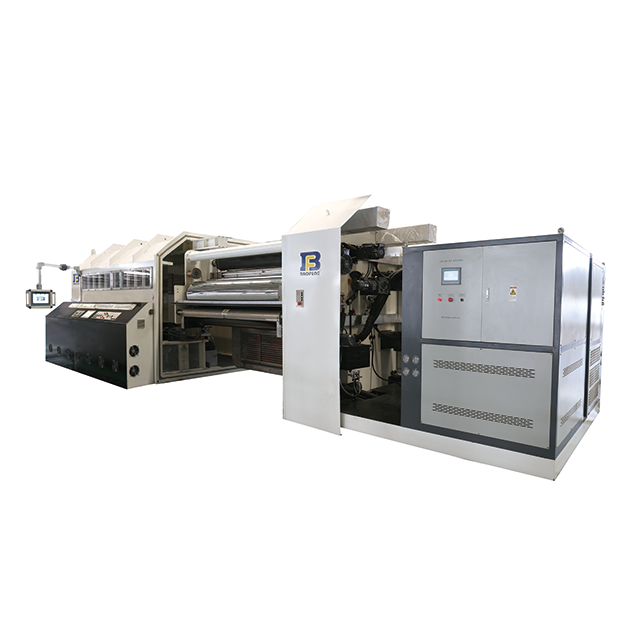
A Free Span Metallizer fundamentally alters the coating process. The substrate moves freely through the evaporation zone. It experiences absolutely no direct backing-roller contact on the coated side. This contactless processing zone represents a revolutionary shift. It eliminates the primary source of physical web damage. The film glides smoothly above the aluminum vapor cloud.
You no longer rely on a traditional chilled drum for cooling. Instead, the system uses precise, localized tension isolation. Advanced induction heating synchronization manages the thermal load perfectly. These systems apply controlled energy exactly where needed. Specialized tension zones keep the web completely flat. They prevent the web from sagging or wrinkling under high heat. This delicate balance requires sophisticated digital controls.
Removing physical contact points works wonders for defect elimination. It prevents metallized layer transfer entirely. Industry professionals call this specific defect "pick-off." It also eliminates substrate scratching completely. The aluminum layer forms perfectly without mechanical interference. Your films emerge pristine, uniform, and ready for lamination.
Applying traditional mechanical tension formulas to contactless zones.
Ignoring ambient humidity impacts on static generation before the vacuum chamber.
Failing to recalibrate tension load cells during substrate changeovers.
Evaluating new equipment requires a focus on actionable data. You must analyze net speed versus gross speed. A free span system maintains high deposition rates easily. It does not force a trade-off in barrier consistency. Traditional machines might run faster on paper. However, their defect rates lower the actual net usable speed. Contactless architecture ensures every coated meter remains viable.
Scrap reduction directly transforms your raw material ROI. Fewer web breaks occur during complex runs. Edge-curling virtually disappears on ultra-thin gauges. You waste less expensive polymer substrate. Every successful roll adds to your bottom line. Manufacturers often see double-digit reductions in raw material waste within months.
Maintenance uptime improves dramatically under this new architecture. You clean cooling drums much less frequently. Worn contact rollers become largely obsolete. Scheduled maintenance windows shrink considerably. Your maintenance teams can focus on preventative sensor calibration instead of reactive mechanical repairs.
Metric Category | Traditional Drum Setup | Free Span Architecture |
|---|---|---|
Defect Generation | High risk of pick-off and micro-scratching | Virtually zero contact-induced defects |
Thermal Stress | Prone to sudden thermal shock and curling | Gradual, isolated thermal management |
Maintenance Needs | Frequent drum cleaning and roller replacement | Minimal mechanical wear, high sensor reliance |
Net Usable Yield | Moderate to low on ultra-thin substrates | Consistently high across all film gauges |
Medical packaging strictness dictates absolute operational perfection. Sterilization-grade films require 100% barrier uniformity. Pharmaceutical blisters demand consistent protection against moisture. A Free Span Metallizer plays a crucial role here. It maintains perfectly flat profiles during deposition. This eliminates the micro-cracks usually caused by roller tension. Your medical webs pass ISO compliance checks confidently.
Food-grade barrier consistency relies on flawless execution. Improved coating adhesion happens naturally in a free span setup. The system incorporates continuous optical density (OD) monitoring. This tracks performance in real-time across the web width. High OD uniformity ensures verifiable shelf-life extensions for sensitive foods. Coffee and snack packaging benefit immensely from this stability.
Consistent web handling acts as a powerful risk mitigation tool. It reduces the distinct risk of compliance audits flagging variations. Batch-to-batch consistency becomes your manufacturing standard. You eliminate the physical variables causing barrier fluctuations. Auditors look for reliable, repeatable processes. A contactless system provides exactly this level of verifiable control.
Upgrading your line involves serious engineering realities. Subsystem compatibility requires careful evaluation beforehand. You must integrate free span modules with existing infrastructure. Check your current vacuum pumps for capacity matches. Verify your winding systems can handle digital tension feedback. The entire metallizing ecosystem must synchronize flawlessly. Older PLCs might require immediate communication upgrades.
You must address substrate limitations transparently. Know your specific film portfolio intimately. Certain biodegradable polymers need highly specialized tension tuning. Ultra-low gauge films require careful digital calibration to prevent stretching. You cannot run a universal profile for every material. Each polymer demands a unique thermal and tension recipe.
Operator adoption presents a significant rollout challenge. Digital tension monitoring involves a steep learning curve. It differs greatly from traditional mechanical web handling. Operators can no longer rely on physical touch to gauge tension. They must trust digital interfaces. Robust vendor training remains absolutely essential for success.
Audit your existing vacuum pumping capacity and winding drive precision.
Establish digital tension baseline profiles using standard PET films.
Conduct trial runs with highly sensitive biodegradable or ultra-thin medical substrates.
Train shift supervisors exclusively on induction heating synchronization software.
Transition full production while maintaining parallel quality assurance testing.
Manufacturers hitting a plateau in yield quality must look beyond traditional mechanics. Moving to a free span architecture provides a distinct strategic advantage. It eliminates the physical friction compromising high-barrier films. You achieve higher net usable speeds, lower scrap rates, and superior barrier consistency. This transition secures your position in demanding medical and food-grade markets.
Operational leaders should adopt a strict shortlisting framework. Begin by benchmarking your current scrap rates. Compare your historical defect logs against projected OEE improvements of a contactless system. Look specifically at your downtime attributed to web breaks and roller maintenance. The data will likely justify the structural upgrade.
Do not let mechanical limitations dictate your production capacity. We recommend scheduling a substrate-specific trial run. Consult directly with a vacuum metallization engineer to evaluate your baseline compatibility. Take action today to modernize your web handling ecosystem and secure long-term operational efficiency.
A: Ultra-thin films, heat-sensitive biodegradable polymers, and high-clarity medical webs benefit the most. These specific materials are highly prone to thermal distortion or mechanical scratching when processed on traditional chilled cooling drums.
A: By isolating tension and eliminating drum-induced wrinkles, it maintains a perfectly flat web profile across the evaporation source. This stable, contactless presentation directly results in highly uniform optical density across the entire film width.
A: While it eliminates the need to clean contact rollers frequently, it does shift the maintenance focus. Technicians must concentrate on calibrating digital tension sensors and maintaining the intricate induction heating ecosystem rather than replacing mechanical parts.
A: It varies by production volume. However, ROI is typically driven by the direct reduction in rejected medical and food-grade rolls. Fewer web-break-induced downtimes also contribute heavily, often modeling out within 18–24 months for high-capacity lines.