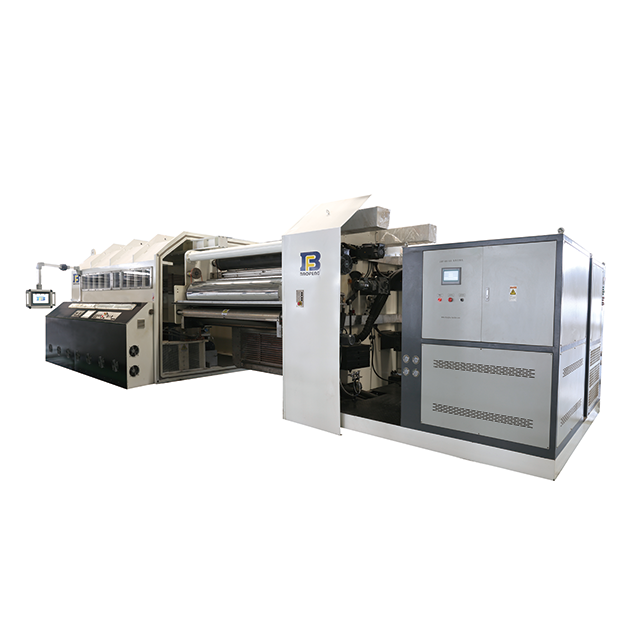
Views: 0 Author: Site Editor Publish Time: 2026-08-07 Origin: Site
The medical packaging sector operates on strict zero-tolerance margins for error. A single compromised barrier can trigger catastrophic compliance failures. Regulatory standards like ISO 11607 demand absolute precision. Consequently, product recalls quickly follow any hygiene or structural breach. Converters rely heavily on flawless metalized films to maintain sterile boundaries. Traditional chill-roll metallization remains the industry standard today. However, forward-thinking manufacturers actively evaluate alternative deposition methods. They want to eliminate surface contamination caused by physical drum contact. This article evaluates one such alternative process. We will objectively analyze whether a Free Span Metallizer can meet these intense demands. We assess the critical thermal, tension, and barrier requirements necessary for medical-grade production. Readers will learn how this technology works, its core advantages, and its severe limitations.
The Verdict: A Free Span Metallizer can be suitable for highly specific medical-grade applications, but only when paired with thermally stable substrates (like PET) that can withstand high heat without a chill roll.
Primary Advantage: Suspending the web eliminates direct contact with a cooling drum, drastically reducing the risk of micro-scratches, drum-transferred contamination, and pinholing.
Primary Risk: Without the conductive cooling of a chill drum, managing the thermal load of the aluminum deposition is highly complex, making it unsuitable for heat-sensitive webs (like thin CPP or PE) common in medical packaging.
Evaluation Path: Adoption requires a strict cost-benefit analysis weighing contamination reduction against web-handling limitations and restricted substrate versatility.
Manufacturing medical films requires entirely different quality paradigms compared to food packaging. Medical converters face intense scrutiny. They must prove continuous compliance through rigorous physical testing. To understand alternative deposition methods, we first establish baseline success criteria. Every medical-grade film must clear four major operational hurdles.
Zero-Defect Barrier Requirements: Medical packaging demands near-perfect Oxygen Transmission Rates (OTR). It equally requires flawless Moisture Vapor Transmission Rates (MVTR). High-performance barriers protect sensitive pharmaceutical compounds. They also preserve the sterility of surgical devices. Any fluctuation in these transmission rates ruins the sterile boundary.
Pin-Hole Elimination: Microscopic defects often occur during standard film handling. These tiny gaps in the metal layer invite catastrophic failures. Packages undergo aggressive sterilization processes. Autoclave cycles introduce intense heat and pressure. Gamma irradiation alters polymer structures. Ethylene Oxide (EtO) gas penetrates weak spots. A medical film must survive these sterilization methods without barrier degradation.
Metal Adhesion Strength: The deposited aluminum layer must bond fiercely to the base polymer. Weak adhesion causes severe downstream issues. Medical films face aggressive converting environments. High-speed lamination machines apply intense mechanical stress. Pouch-forming equipment folds and seals the edges aggressively. The metal layer must never delaminate during these phases.
Hygienic Integrity: Cleanroom environments dictate strict particulate limits. The production equipment itself must minimize particle generation. Physical machine components often cause subtle surface scratching. Cross-contamination from previous runs remains a constant threat. High hygienic integrity ensures a pristine, medical-safe final roll.
To grasp the impact of suspending the web, we must compare it against legacy systems. The vacuum metallization process vaporizes aluminum wire at extreme temperatures. This vapor condenses onto a moving polymer web. Managing the resultant physics separates good films from failed batches.
Standard metallizers rely heavily on a massive chilled drum. The machine wraps the polymer film tightly around this rotating cylinder. Operators typically maintain the drum temperature between -15°C and -20°C. Vaporized aluminum releases immense latent heat upon condensation. The cold drum absorbs this intense thermal energy through direct conductive cooling. This rapid heat transfer prevents the polymer substrate from melting.
Free span technology entirely removes the cooling drum from the coating zone. The machine suspends the film between two tension rollers. We call this suspended area the "free span." The web travels directly over the aluminum evaporation boats. Neither the coated side nor the uncoated side touches any solid surface during deposition. This contactless approach fundamentally changes the thermodynamics of the entire coating chamber.
Suspending a fast-moving web in a vacuum introduces severe mechanical challenges. Advanced servo-driven tension isolation zones become mandatory. Standard machines rely on drum friction to stabilize the film. A Free Span Metallizer cannot rely on this friction. Instead, it uses high-precision load cells and proprietary control loops. These systems monitor and adjust web tension milliseconds at a time.
Poor tension control causes web flutter. Fluttering occurs when the suspended film vibrates above the evaporation source. Even minor vibrations disrupt the aluminum condensation pattern. This creates uneven coating thickness. In uniform medical packaging, uneven deposition instantly fails quality assurance tests.
Process Feature | Traditional Chill-Roll | Free Span Technology |
|---|---|---|
Cooling Mechanism | Conductive (Direct drum contact) | Radiative (No direct contact) |
Web Stabilization | Drum friction and wrap angle | Servo-driven tension rollers |
Heat Management | Highly efficient (-20°C absorption) | Highly complex (Heat remains in web) |
Surface Contact | Uncoated side touches drum | Zero contact during deposition |
Despite the inherent mechanical challenges, suspending the web offers distinct purity benefits. Medical packaging highly prizes surface cleanliness. Removing the cooling drum eliminates several common contamination pathways. We observe three primary advantages when utilizing this deposition method.
Elimination of Chill Roll Contamination: Direct contact between a polymer and a cold drum creates issues. Polymers often contain low-molecular-weight additives called oligomers. These oligomers migrate to the film surface. They transfer onto the cold drum during traditional processing. The drum then deposits these residues onto subsequent film layers. Furthermore, vacuum chamber dust settles on horizontal drum surfaces. Free span architecture completely removes this physical touchpoint. It cuts off the primary avenue for cross-contamination.
Reduction of Mechanical Damage: Chill rolls are massive, heavy components. Films wrapped tightly around them experience intense pressure and friction. Minute speed variations between the web and the drum cause micro-slippage. This slippage generates microscopic scratches on the film surface. Scratches disrupt the polymer's smoothness. When aluminum condenses over a scratch, it forms a pinhole. Removing the drum preserves the structural integrity of the base substrate.
Bilateral Purity: Preserving the uncoated side matters just as much as the coated side. Medical packaging often requires multi-layer laminations. Converters must treat the uncoated side for downstream bonding. Drum contact lowers the natural surface energy of the film. Avoiding this contact keeps both sides pristine. Pristine surfaces react much better to subsequent plasma or corona treatments. This guarantees uniform adhesion across the entire finished pouch.
While the purity advantages sound ideal, the physics of vacuum deposition present severe roadblocks. Converting aluminum wire into vapor requires temperatures exceeding 1500°C. When this vapor condenses on the moving film, it releases massive latent heat. Managing this thermal load represents the biggest hurdle for contactless systems.
Traditional systems use conductive cooling. Conductive cooling transfers heat rapidly through direct physical contact. Without a chill roll, the substrate relies entirely on radiative cooling. Radiative cooling emits heat away from the film into the surrounding vacuum. This method proves vastly less efficient. The polymer must absorb and hold the heat energy until it exits the deposition zone.
Medical packaging frequently utilizes heat-sensitive films. Cast Polypropylene (CPP) and specialized Polyethylenes (PE) provide excellent sealant properties. However, their thermal tolerance remains quite low. These materials possess a low Glass Transition Temperature (Tg). When exposed to intense latent heat in a free span setup, they soften rapidly. High web tension pulls on the softened film. The substrate immediately stretches, wrinkles, or melts completely.
Web stretching causes catastrophic failures in the barrier layer. Imagine the film elongating slightly under heat and tension. The aluminum vapor condenses and solidifies into a rigid metal layer on this stretched surface. As the film leaves the hot zone, it cools and shrinks back to its original dimensions. The rigid metal layer cannot shrink. It develops thousands of invisible micro-cracks. These cracks instantly destroy the OTR and MVTR barriers required for medical compliance.
Operators must find ways to manage this heat without a drum. The most common solution involves drastically reducing line speeds. Slower speeds mean less aluminum deposits per second. This lowers the immediate thermal impact on the film. However, slower line speeds ruin production economics. Converting facilities rely on high throughput to maintain profitability. Sacrificing speed for contactless purity often breaks the financial model.
Evaluating this technology requires strict pragmatism. The decision heavily depends on your specific product portfolio. Converters cannot force heat-sensitive materials through a contactless system. You must align your machine choices with your primary substrate formulations.
Substrate Type | Thermal Stability | Free Span Suitability | Typical Medical Use |
|---|---|---|---|
BOPET (Polyester) | Excellent | Highly Recommended | Outer barrier webs, rigid pouches |
Polyimide (PI) | Superior | Highly Recommended | High-temperature sterilization |
BOPP | Moderate | Proceed with Caution | General medical overwraps |
CPP / PE | Very Low | Not Recommended | Inner sealant layers, soft blisters |
Review your primary production volumes. If your products rely on robust, thermally stable films, you have a match. High-grade PET or Polyimide handles radiative cooling effectively. In these cases, a Free Span Metallizer becomes a highly viable option for ultra-pure applications. Conversely, do you process large volumes of multi-layer polyolefins? If you rely on PE or thin CPP, avoid contactless systems entirely. You must stick to advanced chill-roll systems to prevent material melting.
Many converters opt for hybrid solutions instead. You can achieve medical-grade purity without sacrificing substrate versatility. Consider installing traditional chill-drum metallizers equipped with advanced surface treatments. In-line plasma treaters clean the web just before deposition. Automated web-cleaning rollers remove dust before the film hits the drum. These upgrades mimic the purity of free span setups while retaining superior thermal management.
If you plan to pursue contactless technology, proceed methodically. First, conduct comprehensive thermal modeling on your specific substrate formulations. Understand exactly how your polymers behave under high radiative heat. Second, request pilot-scale sample runs from equipment manufacturers. You must test the post-metallization OTR and MVTR levels rigorously. Finally, execute aggressive tape tests and lamination peel tests. Verify the metal adhesion strength matches your legacy chill-roll benchmarks.
Alternative deposition methods force converters to balance purity against physical limitations. A free span setup offers distinct theoretical advantages. It successfully eliminates drum contact. This drastically reduces mechanical damage, micro-scratches, and oligomer transfer. Both sides of the film remain pristine for downstream processing.
However, the severe limitations in thermal management cannot be ignored. The inability to efficiently cool the web makes processing polyolefins nearly impossible. This technology serves as a highly specialized niche solution. It is not a universal upgrade for general medical film production.
We recommend packaging converters carefully assess their primary substrates. You should prioritize high-end chill-roll metallizers featuring superior tension control and plasma treatments for standard webs. Reserve contactless technology strictly for high-temperature, heat-resistant barrier films. Always validate your barrier integrity through extensive pilot testing before full-scale integration.
A: It can reduce pinholing caused by mechanical damage from drum contact. However, poor thermal management often causes the web to stretch or distort. This distortion creates micro-cracks in the metal layer upon cooling. Ultimately, these micro-cracks ruin the barrier properties entirely. True barrier improvement only happens when using highly heat-resistant substrates.
A: Thermally stable substrates perform best. High-grade PET (Polyester) and Polyimide handle the intense radiant heat effectively without warping. Conversely, heat-sensitive films like Polyethylene (PE) or Cast Polypropylene (CPP) are highly vulnerable. They easily stretch, melt, or wrinkle in a contactless environment.
A: Adhesion relies heavily on advanced pre-treatment methods like plasma or corona systems. It also depends on the inherent surface energy of the pristine, untouched web. Because the film never touches a drum, the surface remains highly receptive to metal bonding. However, the lack of rapid conductive cooling can sometimes negatively affect the crystalline structure of the deposited metal.